
Medicare is a federal health insurance program designed for people aged 65 and older (or disabled/having certain diseases). It is divided into different parts. Part A, which is free for most people (usually this is 10 years of work paying FICA taxes), covers inpatient hospital stays, hospice care, some care in a skilled nursing facility, and some home health care. Part B covers doctors' services, outpatient care, medical supplies, and preventive services. Part D helps with prescription drug costs. There are monthly premiums for Part B and Part D. When enrolling in Medicare, you can choose between Original Medicare and Medicare Advantage.
Original Medicare (Part A and Part B) offers more flexibility in selecting healthcare providers, while Medicare Advantage (also known as Medicare Part C) functions as an all-in-one alternative with more structured coverage but less control over provider choices. Medicare Advantage is covered by private insurance companies. Because Original Medicare alone may not cover all medical expenses, many people buy a Medicare supplemental insurance (known as Medigap) to help with costs such as deductibles, copayments, and coinsurance.
We partner with health insurance providers such as United Healthcare, Blue Cross, Aetna, HealthSpring, Humana, etc, and provide the following services:
To join a Medicare Advantage Plan (Part C), you need both Part A and Part B. To join a Medicare drug plan (Part D), you only need Part A or Part B.
You can withdraw money from your HSA (Health Savings Account) after your Medicare coverage starts to help pay your share of costs (like deductibles, premiums, coinsurance or copayments). However, this does not apply to Medigap premiums.
If your Medicare coverage overlaps when you make HSA contributions, you’ll have to pay a tax penalty.
To avoid a tax penalty, you and your employer may stop contributing to your HSA 6 months before you apply for Medicare. This is because: 1) You're not eligible to make contributions to your HSA after you have Medicare; 2) Your Part A coverage may start up to 6 months back from the date you sign up for Medicare or apply for benefits from Social Security (or the Railroad Retirement Board). You may also contact your HSA plan administrator to withdraw the contributions for the months that overlap your Medicare coverage.
Initial Enrollment Period (IEP)
Typically, the Initial Enrollment Period (IEP) starts around the time when you turn 65. It lasts for 7 months, starting 3 months before you turn 65, and ending 3 months after the month you turn 65 (unless your birthday is on the first of the month, in which case your initial enrollment period starts 4 months before you turn 65 and ends 2 months after the month you turn 65, and your Medicare coverage generally starts the first day of the month before you turn 65). The date your coverage starts depends on which month you sign up during your IEP. Coverage always starts on the first of the month. During the IEP, you can also enroll in a standalone Part D prescription drug plan (PDP) or a Medicare Advantage plan that includes drug coverage (MA-PD).
General Enrollment Period (GEP)
The Medicare General Enrollment Period (GEP) is between January 1 and March 31 each year. The GEP is an opportunity for those who missed their initial Medicare enrollment window to enroll in Medicare Parts A and/or B. If you sign up during the GEP, your coverage starts the month after you sign up. You might pay a monthly late enrollment penalty, if you don’t qualify for a Special Enrollment Period.
Special Enrollment Period (SEP)
After your Initial Enrollment Period (IEP), there are certain situations when you can sign up without paying a late enrollment penalty. This is called your Special Enrollment Period (SEP). If you don’t sign up during your SEP, you’ll have to wait for the next General Enrollment Period (GEP), and you might have to pay a monthly late enrollment penalty.
One special situation is when you have eligible group health insurance through your job, your spouse’s job (or a family member’s job if you’re disabled). In this case, your SEP starts the first month after your IEP and ends 8 months after the group health plan coverage or the employment ends, whichever happens first. Generally, your coverage begins the first month after you sign up. If you sign up for Part B while you're still working, or within the first full month after losing employer coverage, you can request to delay your Part B start date up to 3 months.
Annual Enrollment Period (AEP)
The AEP, also known as the Medicare Open Enrollment Period, runs from October 15 to December 7 each year. During this time, people with Medicare can switch between Original Medicare and Medicare Advantage plans, join or switch Part D plans, or make other coverage changes. Changes made during the AEP take effect on January 1 of the following year.
The Medicare Advantage Open Enrollment Period runs between January 1 and March 31 of each year or within the first 3 months you get Medicare. This is only for those who already have a Medicare Advantage (MA) plan. You may switch to another Medicare Advantage Plan with or without drug coverage, or drop your Medicare Advantage Plan and return to Original Medicare. You may also join a separate Medicare drug plan. Note that you may join a Medicare Advantage Plan or a Medicare drug plan during the Medicare IEP, AEP, or SEP.
The best time to enroll in a Medigap (Medicare Supplement) plan is during your Medigap Open Enrollment Period. This period is a one-time, six-month window that starts when you're 65 (or older) and first get Part A and Part B. During this period, insurance companies cannot deny you coverage or charge you more due to pre-existing health conditions, and you can buy any Medigap policy sold in your state, even if you have health problems.
After your Medigap Open Enrollment Period ends, you might not be able to buy a Medigap policy. If you’re able to buy one or want to switch policies later, it may cost more.
There are certain special qualifying events that people may enroll in Medigap outside of the Medigap Open Enrollment Period. Such qualifying events may include instances when people involuntarily lose certain types of supplemental coverage, such as when an employer cancels retiree coverage or when a Medicare Advantage plan discontinues coverage in their area.
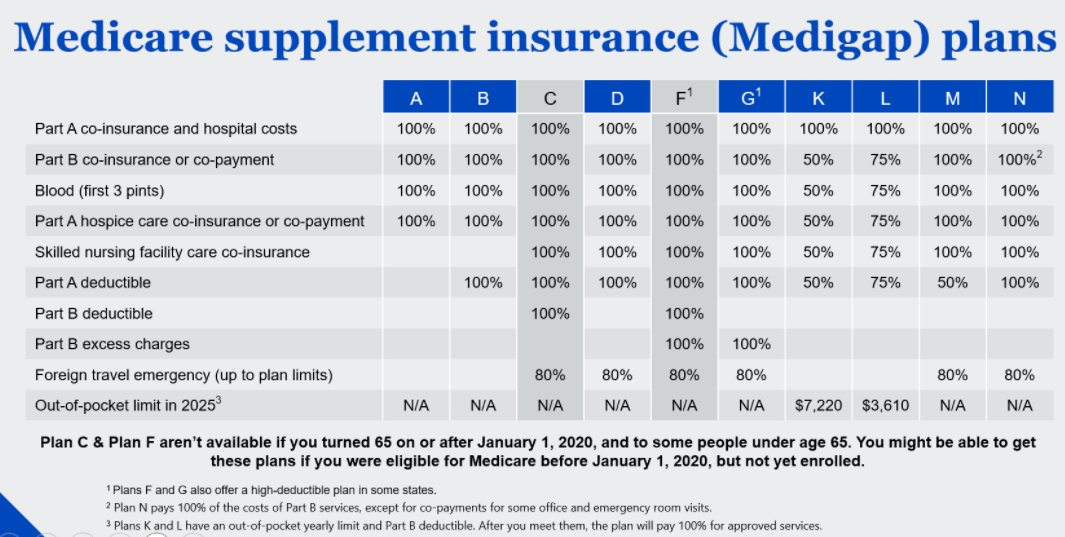
Medigap plans are standardized and denoted by letters A through N. All Medigap plans with the same letter must offer the same basic benefits, regardless of the insurance company selling them.
Generally, you pay a monthly premium for Medicare coverage and part of the costs each time you get a covered service. There’s no yearly limit on what you pay out-of-pocket, unless you have supplemental coverage, like a Medicare Supplement Insurance (Medigap) policy, or you join a Medicare Advantage Plan. Medicare premiums depend on income levels and may trigger Income-Related Monthly Adjustment Amounts (IRMAA), based on your MAGI (modified adjusted gross income) in the prior prior year.
2026 Medicare Part A
| Part A Deductible and Coinsurance | |
|---|---|
| Deductible (each benefit period) | $1,736 |
| Hospital coinsurance (days 61-90) | $434 |
| Hospital coinsurance (lifetime reserve days) | $868 |
| Skilled nursing facility coinsurance (days 21-100) | $217 |
2026 Medicare Part B Premiums and IRMAA (deductible: $283)
| 2024 Single MAGI | Joint MAGI | Premium (not held harmless) | Premium Level |
|---|---|---|---|
| ≤ 109,000 | ≤ 218,000 | $202.90 | Standard |
| ≤ 137,000 | ≤ 274,000 | $284.10 | x 1.4 |
| ≤ 171,000 | ≤ 342,000 | $405.80 | x 2.0 |
| ≤ 205,000 | ≤ 410,000 | $527.50 | x 2.6 |
| < 500,000 | < 750,000 | $649.20 | x 3.2 |
| ≥ 500,000 | ≥ 750,000 | $689.90 | x 3.4 |
2026 Medicare Part D Premiums and IRMAA (OOP Max: $2,100)
| 2024 Single MAGI | Joint MAGI | Premium |
|---|---|---|
| ≤ 109,000 | ≤ 218,000 | Plan Premium |
| ≤ 137,000 | ≤ 274,000 | + $14.50 |
| ≤ 171,000 | ≤ 342,000 | + $37.50 |
| ≤ 205,000 | ≤ 410,000 | + $60.40 |
| < 500,000 | < 750,000 | + $83.30 |
| ≥ 500,000 | ≥ 750,000 | + $91.00 |
If you plan to keep working past age 65 or have employer health coverage through a spouse, you have some options to consider before signing up for Medicare.
Before you do anything about enrolling in Medicare, you need to talk with your employer’s benefit manager. You need to understand if your employer’s insurance qualifies as creditable coverage that could allow you to delay Medicare and find out how Medicare and your employer’s coverage may work together. In some cases, your employer’s coverage will enable you to put off Medicare enrollment, and in other cases, you may be required to take full Medicare benefits at age 65 even if you continue working.
If you qualify to delay both Medicare Parts A & B, you can do so without penalty as long as you enroll within the eight months of your Special Enrollment Period and will also need to provide written proof of creditable drug coverage to avoid Part D penalties.
The Affordable Care Act (ACA), also known as Obamacare, provides comprehensive health insurance plans, so that individuals and families may have access to affordable and high-quality healthcare coverage. ACA plans cover essential healthcare benefits (hospitalization, doctor's visits, preventive care, prescription drug, and more), with no exclusions for pre-existing conditions.
The ACA Open Enrollment for 2027 coverage is expected to begin on November 1, 2026, and end on December 15, 2026, for most states. Coverage will begin on January 1, 2027 for those who enrolled or changed plans by December 15th and paid their first premium. If you qualify for a Special Enrollment Period due to a life event (marriage, birth, adoption, loss of coverage, or a move, etc), you may apply outside of the Open Enrollment Period.
This page is for general information only and is not intended to provide specific advice
for any individual.