
What are Alternative Investments?
Alternative investments are financial assets that are not considered conventional investments such as stocks, bonds, and cash. Examples of alternative investments are hedge funds, private equity, venture capital, private real estate, private credit, commodities, etc.
Many wealthy individuals choose to invest a portion of their assets in alternative investments. A survey from global investing firm KKR found that high-net-worth (HNW) investors (those with a net worth of at least $1 million) allocated 25% of their assets to alternative investments in 2020. Ultra-high-net-worth (UHNW) investors (those with a net worth of at least $30 million) had 50% of their assets in alternative investments.
Historically, HNW investors have allocated around 50% of their assets to stocks, 20% to bonds, 25% to alternatives and 5% to cash, global investment firm KKR noted in 2021. UHNW investors have allocated around 30% to stocks, 10% to bonds, 50% to alternatives and 10% to cash.
Why Alternative Investments?
There are a few reasons why people use alternative investments:
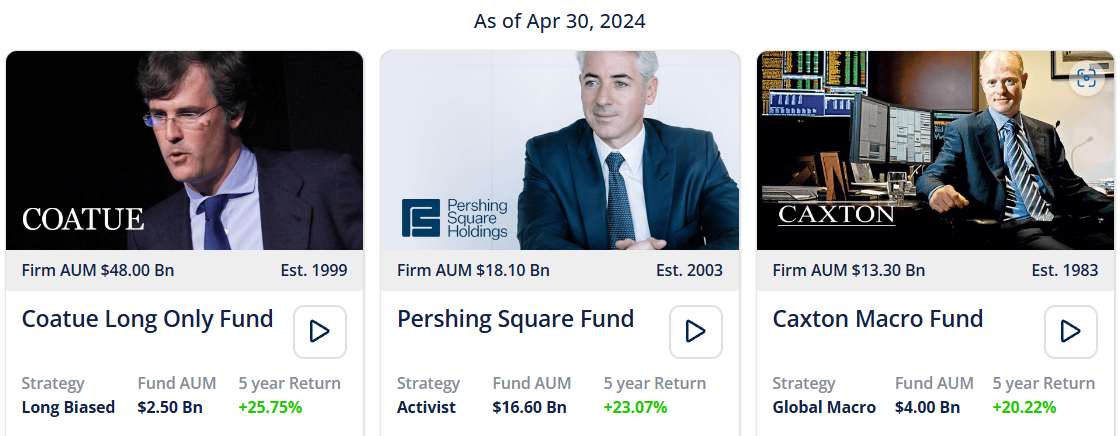
Below is a sample of three hedge funds with their average annualized 5-year return rates as of April 30, 2024. Past performance is no guarantee of future results.
Investment Choices
We partner with dozens of top hedge funds and private market funds (including private equity, venture capital, private real estate, private credit, etc), and can help you create a portfolio that consists of different hedge funds and private market funds, based on your situation. The portfolio is tailored for you with your input and consensus.
What are the Requirements?
Alternative investments are meant for high net worth individuals and are not open to the average investor. On our platform, the minimum investment per portfolio is $1 million and the minimum investment in a particular fund inside the portfolio is $100,000. A portfolio may consist of several funds. Other restrictions also apply. Contact us for the specifics.
Where is Your Money Held?
The account will be opened under the client's name at Bank of New York (BNY), which is the custodian. Ernst & Young is the auditor. The money is held and managed inside this account until the client requests to close the account (without penalty); then the money will be transferred directly to the client's new designated account. Founded in 1784, currently overseeing nearly $50 trillion in assets, BNY is the country's oldest bank and the longest continuously operating company in New York City.
What is a Hedge Fund?
A hedge fund is a private pool of capital managed by an investemnt advisor. Hedge funds are similar to mutual funds and ETFs in that they are pooled and professionally managed but differ in that the funds cater to qualified investors and have more flexibility in their investment strategies. Unlike mutual funds and ETFs, hedge funds can invest multi-directionally (long or short) and invest in both traditional markets such as stocks and bonds, as well as non-traditional markets such as commodities, currencies, and derivatives.
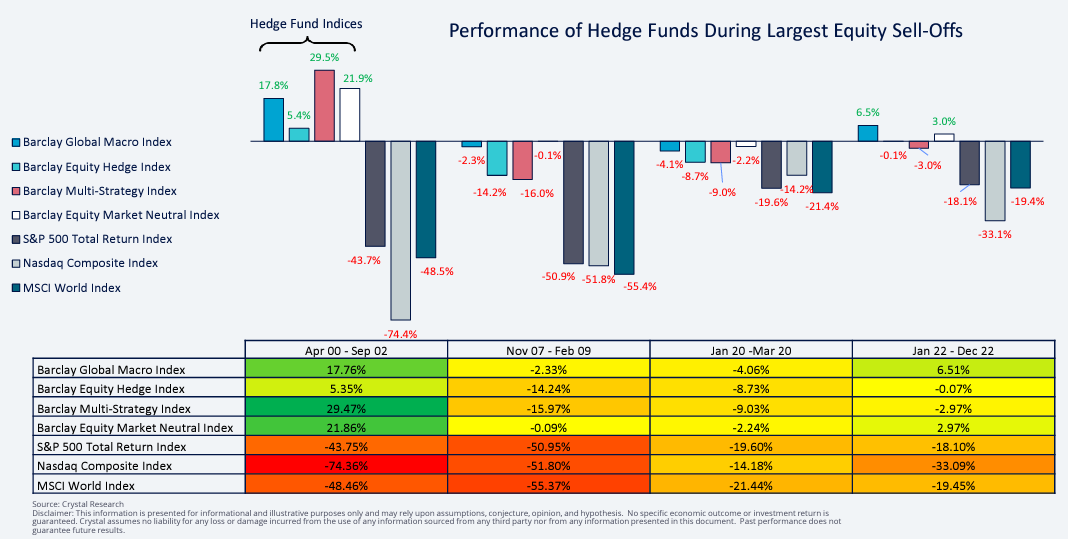
Hedge funds provide drawdown protection, enhanced portfolio diversification, low correlated strategies, and a differentiated source of returns. Below is an example of the risk management feature provided by hedge funds, based on historical data. Past performance is no guarantee of future results.
Top universities are well-known in investing a big percentage of their endowments in hedge funds and private market funds (Harvard: 78%, Yale: 90%, Stanford: 75%, Princeton: 78% in 2023). In addition, the average U.S. public pension plan invests 39% of its assets in hedge funds and private market funds in 2021, rising from 15% in 2001.
References
This page is for general information only and is not intended to provide specific advice for any individual. All performance referenced is historical and is no guarantee of future results. Investing involves risks including possible loss of principal.